

Who doesn’t love dolmadakia? These delicious stuffed vine leaves are enjoyed across many countries, each with its own twist. Some call them dolma, others dolmadakia, and in Cyprus, we call them koubepia. Do you know of any other names?
Why We Love Dolmadakia
I grew up eating koubepia almost every week. My grandmother was a master at rolling them. She had a wood-fired oven and would prepare trays of dolmadakia in seconds, often cooking them alongside tavva or lamb kleftiko. That same oven also baked her famous koulouria. Honestly, I don’t know how she managed it all—when she was younger, she was such a boss! I miss those years, and I especially miss her.
For me, dolmadakia aren’t just food—they’re comfort, family, and tradition all wrapped in tender vine leaves.
Now, even though I love eating dolmadakia, I don’t particularly like rolling them…there I said it. Hence, below you will find an easier way of enjoying dolmadakia.
The Lemon Factor
Here’s a little confession: I love mine very lemony! 🍋
The recipe I’m sharing uses quite a bit of lemon juice, but if you don’t like too much acidity, feel free to use less. Personally, I think the lemon elevates the dish—it pairs beautifully with the vine leaves and balances the richness of the filling.
The Vine Leaves Matter
The quality of your vine leaves can make or break your dolmadakia.
- If they’re too hard, the texture won’t be pleasant.
- If they’re too soft, they may fall apart during cooking.
- If they’ve been preserved too long, the flavor can turn strange.
👉 Tip: Wash your vine leaves thoroughly before using. If they’re thick, cook them long enough so they soften properly.
The Filling
Traditionally in Cyprus, we use minced pork for koubepia. But honestly, you can adapt this recipe:
- Swap pork for beef, lamb, or chicken.
- Or make it vegetarian by using rice, onions, and fresh herbs.
That’s the beauty of dolmadakia—you can adjust them to your taste and still end up with a delicious dish.
Final Thoughts
Whether you call them dolmadakia, dolma, or koubepia, this is one of those traditional recipes that connects us to our roots. For me, it brings back memories of my grandmother, her wood oven, and family gatherings filled with love and food.
I’d love to see your creations, so please tag me if you make them! And of course, don’t hesitate to reach out if you have any questions.
With love,
Dina x
Step 1 Add the vine leaves to a pot with water and bring to a boil. Let it boil for about 10-15 minutes, depending on the thickness of the leaves. If the leaves are too thick, cook for longer. Once ready, drain and wash with clean, cold water. Step 2 Add the olive oil, onion, and minced meat to a large pot and cook for about 10 minutes. All the meat juices should evaporate. Step 2 Add the tomato, cinnamon, salt, pepper, fresh and dried mint, and parsley. Cook for five more minutes Step 3 Add the lemon juice and rice. Stir well Step 4 Cut the vine leaves as you wish and stir them in the pot Step 5 Preheat oven to 180C Step 6 Pour everything into a baking dish, add enough water to cover the mixture, and cover with foil. Cook for 1 hour or until most of the water has been absorbed. After one hour, remove the foil and continue cooking for 30 more minutes. You are looking for a pilaf consistency, the rice to be cooked, and the water to be absorbed by the rice. You can reduce the lemon juice or increase it depending on what you like. Serve with yummy tzatziki, warm crusty bread and a salad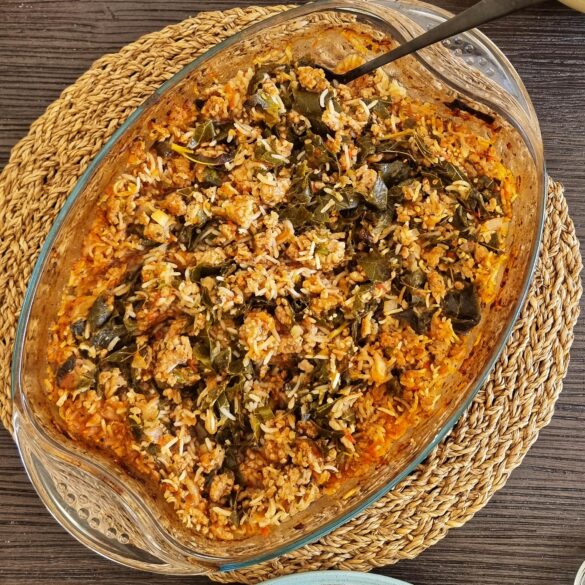
Ingredients
Instructions
Notes
